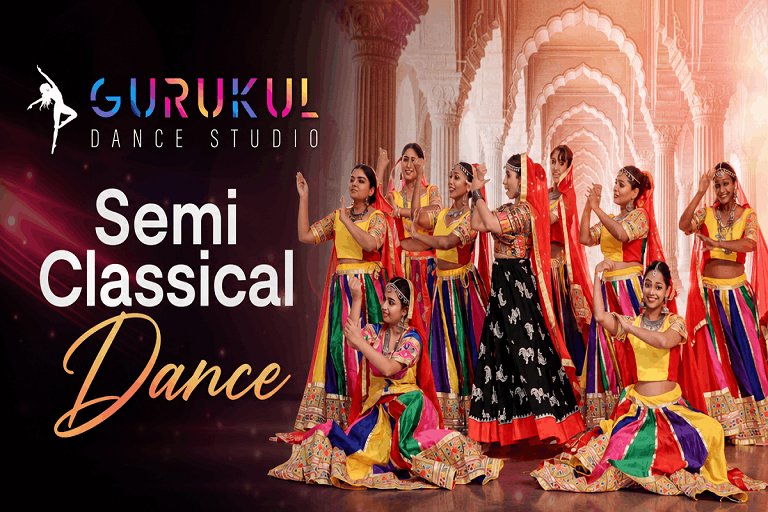
What Is Semi-Classical Dance? A Beginner's Guide
Have you ever seen a performance and felt as though the dancers incorporated aspects of classical dance training but also integrated more modern techniques and styles? This type is referred to as semi-classical dance. People may look for the definition of semi-classical dance because the phrase may seem fashionable and thereby technical, but really it is basic and really not complicated at all. With this being said, we hope that this article answers your questions if you are in Canada, particularly if you are interested in your child participating in dance classes or if you yourself would like to take classes.
Moving along the lines of dance and the arts, we at Gurukul Dance Studio of Calgary get these types of questions all of the time. Hence, our hope is to explain our field without using big words or phrases that only dancers may understand.
Semi Classical Dance Meaning: The Simple Explanation
Classical dances like Kathak and Bharatanatyam have distinctive styles that can be identified immediately by an observer. Semi-Classical dance blends the styles of Classical dance with elements of Bollywood, Folk, and other contemporary dance styles. Thus, it is between Classical and Modern dance styles.
Most importantly, the interpretation and expression of a dancer of a Classical dance style is strictly governed by certain rules, and a deviation from those rules may attract strict criticism. In comparison, a dancer of a Semi Classical dance style can be more expressive and may choose music that is not in the realm of Classical (Raga-based) songs. Thus, a Semi-Classical dance style offers more latitude to a dancer in comparison to Classical dance styles.
Because of the reasons mentioned above, semi-classical dance styles are comparatively easier and more appealing to beginners.
Where Did Semi-Classical Dance Come From?
Semi-classical dance first appeared in the mid 20th century in Indian cinema and theatre. Popular demand for the rise of classical dance allowed choreographers to experiment with different styles of dance integration, including but not limited to folk dance and Western dance.
These experiments shaped the foundation of what is now known as semi-classical dance. When one takes up the study of semi-classical dance, they are exposed to choreography that is less strict and structured compared to pure classical dance, but still holds to tradition.
Classical Dance vs Semi-Classical: What Is The Real Difference?
This is one of the most frequently asked questions at our studio, so here is the answer.
All dance forms have various styles and techniques. Many classical forms have strict rules on training and performance that typically take several years. Some examples of these strict rules are in forms like Bharatanatyam and Kathak.
There are also more informal styles and rules that develop from classical rules, and these are called semi-classical styles. Training in these styles is less strict, and students are permitted to perform choreographed pieces at an earlier stage. Additionally, in semi-classical forms, artists have the freedom to use different styles of music and wear less formal costumes.
While learning to speak a formal language is comparable to learning a classical dance style, learning to have simple conversations in the same formal language is semi-classical dancing.
Popular Semi-Classical Dance Styles You Should Know
The term ‘semi-classical’ encompasses a wide variety of dance styles. These include:
Bollywood fusion dance, which is the integration of popular film dance moves with classical hand movements
Folk fusion, which is classical dance with regional folk dance steps (i.e Bhangra, Garba, etc.)
Thumri and Ghazal dance, which are expressions of the musical rendition in semi-classical form
Contemporary dance, which incorporates and expresses modern notions of dance within the framework of classical dance
The beauty of the various ‘semi-classical’ dance styles is that there is something for everyone, and a particular style does not always need to be appreciated immediately.
Benefits of Learning Semi-Classical Dance
Benefits other than appreciation of Indian culture
Physical Health: Like other disciplines that involve structured physical activity, dance helps in improving physical health by enhancing stamina and flexibility.
Mental Health: Stress and concentration levels are inversely proportional to each other. Dance helps in improving concentration and thus decreasing stress. Semi-classical dance helps in stress relief due to the calming nature of rhythmic dance.
Intangible Benefits: Attendance in classical dance sessions helps kids in Canada’s South Asian communities to appreciate and learn their culture. It helps in building the confidence of kids and adult participants to perform in front of an audience.
Tangible Benefits: Semi-classical dance helps in improving the physical and mental well-being of individuals. It helps in forming connections with other people and appreciating one’s culture.
Is Semi-Classical Dance Good For Kids?
This is one of the most common concerns of parents we receive. Children can start learning different movements of semi-classical dance from the age of 4 or 5. It is a play-based methodology and helps children with motor skills, self-discipline, and coordination.
Can Adults Start Semi-Classical Dance From Scratch?
Of course. Many people think dance training should start when you’re young to have a chance at becoming good at it. At Gurukul Dance Studio, a good number of our adult dance class students are beginners and have never trained in dance. A large portion of them take up dance training to get in touch with their roots. Unlike other classical dance forms, training in semi-classical dance does not require years of training to learn the basics.
What To Expect In A Semi-Classical Dance Class
New to our studio? Here’s what to expect during class:
- To begin, we will go through a brief warm-up to work on stretching and footwork.
- Next, we will work on the correcting of posture and the practice of arm gestures and other movements. We will work on the development of rhythm and timing.
- Then, we will work on short combinations and phrases set to music.
- Finally, we will work on stretching to relax the muscles and work on deepening our breathing.
Keep in mind, classes are divided by age, and you will not need to work on more advanced combinations.
To see what classes are available and to plan your week, visit our schedule!
Semi-Classical Dance Costumes and Music
These costumes allow for more flexibility in your movement and cover less area than full classical attire. This style is also more affordable for newer students of the art. As for music selection, the range in this style includes contemporary pieces based on film music, as well as traditional styles. This adds even more to the accessibility of this dance style within Canada.
Why Learn Semi-Classical Dance in Calgary?
South Asian cultural dance is a passionate and colorful form of expression. Interest and participation in dance among the South Asian community in and around Calgary has increased greatly in recent years. Learning dance at the community level also offers one the opportunity for engagement with the community and to participate in various cultural community events. These opportunities are hard to come by with online instruction.
At Gurukul Dance Studio, our teachers have years of experience in teaching and in dance performance. Our classes are aimed at beginners with no or little experience of semi-classical dance and are structured for them to learn at their own pace.
Ready To Start Your Semi-Classical Dance Journey?
Learning the meaning and background of semi-classical dance is interesting, but the best way to appreciate the art form is to experience it. That means learning the hand gestures and footwork, as well as expressing the emotions embedded in the dance through your facial expressions and body posture. You will make new friends in the process.
You can try this at Gurukul Dance Studio in Calgary. They offer the first class for free. They will allow you to experience something new and exciting, and potentially ignite your passion for semi-classical dance.
Frequently Asked Questions
Semi-classical dance is a fusion of various forms such as classical dance, folk dance, and various other dance forms. Therefore, it offers dancers the opportunity to express themselves in a manner that is beyond the framework of classical dance.
Any dance or music form that is simplified from its classical form is referred to as semi-classical.
The simplest way to learn semi-classical dance is to enroll in a class and learn the posture and rhythm. Once this is acquired, choreography can be learned. At the Gurukul Dance Studio, beginning dancers learn posture and rhythm as it pertains to dance.
Any vocal or instrumental music teacher can instruct the student on a few basics of classical music. With this foundation, learning thumri and ghazals can be of great aid since they are less restrictive.
Kathak is a fully classical dance form like Bharatanatyam and Odissi. However, many Kathak-inspired choreographies fuse different dance forms to create semi-classical dance pieces.