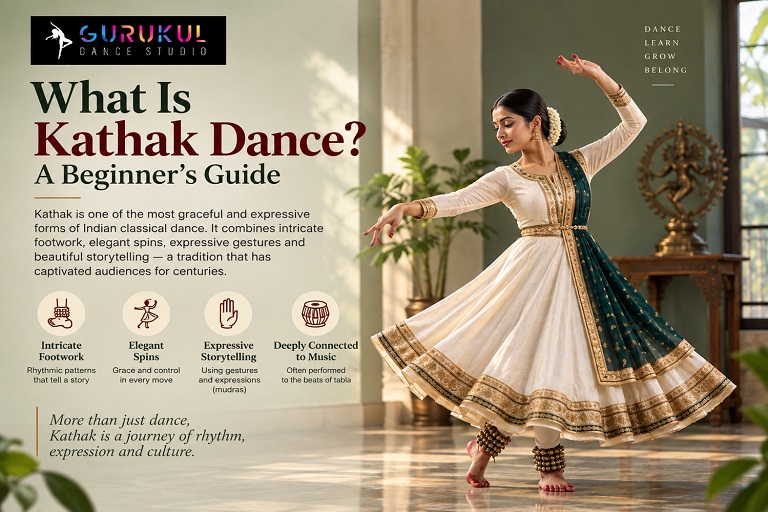
What Is Kathak Dance? A Beginner's Guide
I still remember the first time a student walked into Gurukul Dance Studio and asked, half-nervous, half-curious: “So… what exactly is Kathak?” It’s a question we get a lot, especially here in Canada, where more and more people are stumbling onto this dance form through a wedding video, a Bollywood movie, or a friend who just won’t stop talking about their new hobby.
So let’s actually answer it properly. This is everything you need to know before you take your first Kathak class — no jargon, no assumptions that you already know what a “gharana” is.
What Is Kathak, Really?
Kathak is one of India’s eight classical dance forms, and honestly, it’s less “dance” in the way most people think of it, and more storytelling that happens to involve incredible footwork and spins. The word itself comes from “Katha” (story) and “Kathakar” (the person who tells it). Centuries ago, these were literally traveling storytellers — using their hands, faces, and feet to act out tales from Hindu mythology for village audiences.
Somewhere along the way, that storytelling tradition turned into something much more structured, with its own technique, grammar, and repertoire. And now you’ll find it performed on stages from Mumbai to Mississauga.
A (Very) Brief History
Kathak’s roots are in temples in northern India, where these storytellers performed devotional tales. Then, during the Mughal era, the dance moved into royal courts — and that changed things quite a bit. Suddenly the focus shifted toward technical brilliance: faster spins, sharper footwork, more refined hand gestures, all designed to dazzle royal audiences. But it never fully let go of its devotional, narrative roots either.
This split history is basically why Kathak today has a few distinct “schools,” or gharanas:
- Lucknow Gharana — elegant, graceful, subtle. Think understated expression over raw power.
- Jaipur Gharana — fast, sharp, footwork-heavy. This is the one that will leave you a little breathless just watching it.
There’s also a Banaras Gharana, less talked about but no less rich, which leans into devotional themes while still demanding great technical skill. None of these are “better” than the others — they’re just different flavors of the same tradition.
The Basics Every Beginner Should Know
Before you step into a studio, it helps to have a rough idea of the vocabulary. Here’s what you’ll actually be learning.
- Tatkar (footwork). This is where everyone starts. It’s the rhythmic stomping and stepping that forms the backbone of Kathak — your feet essentially become percussion instruments, matching the beat with precision. It sounds simple. It is not simple. But it’s oddly satisfying once it clicks.
- Chakkars (spins). The thing everyone secretly wants to learn on day one. Kathak dancers can chain together spin after spin while staying locked onto the beat. It takes time to build up to, but there’s nothing quite like the feeling of nailing your first clean chakkar.
- Mudras and hastaks (hand gestures). Every gesture means something. String a few together and a dancer can tell an entire story without a single word — a bird flying, a lover waiting, a storm rolling in.
- Abhinaya (expression). This is the acting side of Kathak. A skilled dancer can shift from joy to grief to mischief just through their eyes and facial expressions. It’s subtle, and it’s honestly one of the hardest things to master.
- Ghungroo (ankle bells). Strapped onto the ankles, these little bells ring out with every footwork pattern, layering extra rhythm on top of the music. Learning to control them — making them ring exactly when you want, and stay silent when you don’t — takes real practice.
Kathak and Music Go Hand in Hand
You can’t really separate Kathak from the music it’s performed to. Tabla and pakhawaj players lay down the rhythmic foundation, and the dancer responds in real time — sometimes almost like a conversation between feet and drums. That live exchange is called jugalbandi, and watching one happen is genuinely one of the most exciting things about a live Kathak show. Vocal styles like thumri and dadra usually come in for the more expressive, story-driven sections.
Okay, But Why Should You Actually Learn It?
Beyond just looking beautiful (which, let’s be honest, is part of the appeal), Kathak comes with some real benefits that surprise a lot of our students.
Physically, it builds flexibility, posture, balance, and serious stamina — those footwork sequences and spins are more of a workout than people expect. Mentally, it sharpens focus and memory, since you’re constantly recalling sequences and staying on rhythm, and it builds a level of discipline that tends to spill over into other parts of life. And culturally, it’s a way to connect with a centuries-old tradition, build confidence through performance, and become part of a genuinely warm community of fellow dancers.
It’s also not an “age-locked” activity. We’ve had six-year-olds and sixty-year-olds in the same building, both getting something completely different — but equally valuable — out of it.
Is It Hard to Learn?
Like most classical art forms, yes — mastering Kathak takes years. But starting it? That’s easy, and you don’t need any dance background at all. Classes usually begin with basic posture, simple footwork, and getting comfortable with rhythm. From there, spins, hand gestures, and expression get layered in gradually.
The honest truth is that consistency matters more than talent here. Ten focused minutes of practice a day will get you further than one long session a week.
What Your First Class Might Look Like
If you’re thinking of trying a class at Gurukul Dance Studio, here’s roughly what to expect:
- A short warm-up to loosen up the body
- Basic standing posture and hand positioning
- Simple footwork at a slow, manageable tempo
- A couple of beginner hand gestures
- A cool-down and stretch to finish
You don’t need anything fancy for your first few classes — just comfortable clothes you can move freely in. As you progress, your instructor will likely suggest a proper Kathak outfit and a pair of ghungroo.
Kathak Is Growing Right Here in Canada
Canada’s South Asian community has been growing for decades, and along with it, interest in classical Indian dance has grown too. Some students find their way to Kathak through Diwali or Navratri events, others through family tradition, and plenty just stumble onto it out of curiosity. At Gurukul Dance Studio, we’ve taught students from every kind of background — you don’t need any prior connection to Indian culture to fall in love with this art form.
You’ll also see Kathak show up at local cultural festivals, weddings, and community showcases across the country, which makes it a genuinely useful skill if you enjoy performing.
Picking the Right Studio
If you’re shopping around for a Kathak class in Canada, a few things are worth checking before you commit:
- Who’s teaching you. Look for instructors with real training under a recognized gharana, not just casual exposure to the style.
- How the class is structured. A good beginner program builds slowly — posture and rhythm first, spins and expression later — rather than throwing everything at you at once.
- Whether there are performance opportunities. Recitals and showcases give students a real reason to apply what they’re learning, and honestly, they’re a lot of fun.
- Whether you can try before you commit. A trial class tells you more than any website ever could. Gurukul Dance Studio offers one for exactly this reason.
Final Thoughts
Kathak isn’t just a dance — it’s storytelling, rhythm, discipline, and expression rolled into one tradition that’s survived centuries for a reason. Whether you’re after a new hobby, a way to stay active, or a genuine connection to a rich cultural art form, there’s a place for you in it.
If any of this has you curious, come find out for yourself. Gurukul Dance Studio would love to have you in our next beginner class — no experience, background, or prior rhythm required. Just bring curiosity, and we’ll handle the rest.
Ready to take your first step? Get in touch with Gurukul Dance Studio and start your Kathak journey today.
Frequently Asked Questions
Not even a little. Flexibility comes with practice — nobody walks in able to do the splits, and that’s completely fine.
There isn’t one. We’ve started kids as young as five and adults well into their sixties. Kathak really doesn’t care how old you are.
Basic footwork and gestures usually come together within a few months of steady practice. Real performance confidence tends to build over a year or two — but that timeline looks different for everyone.
Something stretchy and comfortable that won’t restrict your movement. Bare feet are standard for practice, so skip the sneakers.
No. A few terms come from Hindi or Sanskrit, but instructors explain everything as they go. Plenty of our strongest students didn’t know a word of Hindi when they started.